Kristen Nuss • February 20, 2025

2024 In Review - January 2025

Wow what a Year for 23-003 and the Classic Lear Jet Foundation!


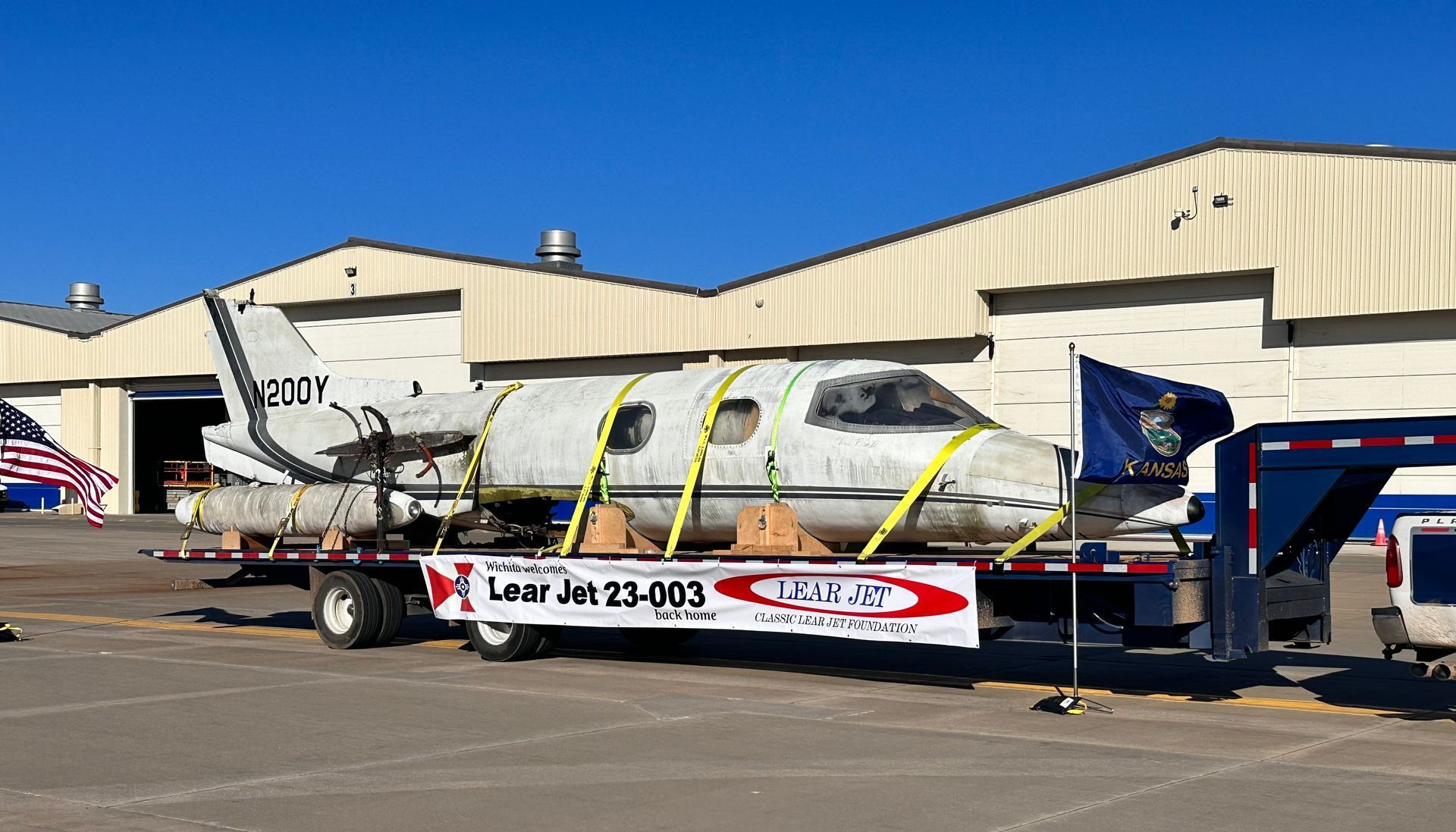
The biggest and most important event of the year was the long term hosting agreement being signed by the Wichita Airport Authority, the City of Wichita, Bombardier and the Classic Lear Jet Foundation! The hosting agreement subleases bays 9 and 10 of building 14 to the CLJF from the primary lease holder, Bombardier. On October 12, 2024, 23-003 N200Y was moved into Bay 9 of building 14, the former Learjet Delivery Center where its restoration process is now serious!

In January we announced that restoration for 23-003 had officially begun with the removal of the first panel, the pilot’s nose avionics door and our first official call for volunteers was sent out. Renowned videographer Tom Zwemke produced a promotional video on the Classic Lear Jet Foundation.


In March the interior was removed from 23-003 and the first inspection, the cabin skin thickness checks were successfully completed. The months since then have seen numerous removals: cockpit instruments, instrument panel, throttle quadrant and floor boards, control column, glareshield, etc. In order to remove the cabin wiring, removal of the circuit breakers from their panels was required. We discovered that 23-003 was built without break plugs between the circuit breaker and its wiring. They are ‘hard wired’! The last of the pilot and copilot circuit breaker panels were finally removed on August 6th.

Read the full newsletter by clicking the button below.
Download Full Newsletter
By Kristen Nuss May 1, 2026
April was a historic month in the restoration of 23-003 N200Y!! First, on April 14 th , after final leveling, the fuselage cradles, jacks and supports were secured firmly to the hangar floor with a special plaster mixture containing hemp fibers (some ropes are made with these fibers). This plaster mixture is commonly used on the factory floor to set tooling jigs so that they cannot move ensuring accurately produced parts and assemblies. With the fuselage secured, we were able to start the removal of skins from the fuselage that need replacement or repair. On April 21, 2026 Hartney Hummer removed the 1st skin panel!! This panel is on the left side of the fuselage, just aft of the engine pylon. This particular panel is not repairable and will have to be replaced. Removal of this panel will also allow the non-destructive inspections (NDI) of the aft fuselage to continue. The NDI test equipment is too big to fit inside the aft fuselage so it will be positioned outside of the stringers pointing inside. International Turbine Industries (ITI) has started the restoration of our CJ610-1 engines. The inspection of the engine cases has started in preparation for them being shipped out to have a coating applied. During earlier discussions between ITI and CLJF, we decided that during the restoration, the engines will be upgraded to the ‘dash 4’ (CJ610-4) configuration. The CJ610-4 engine is a previously approved FAA configuration for the Model 23.
By Kristen Nuss April 1, 2026
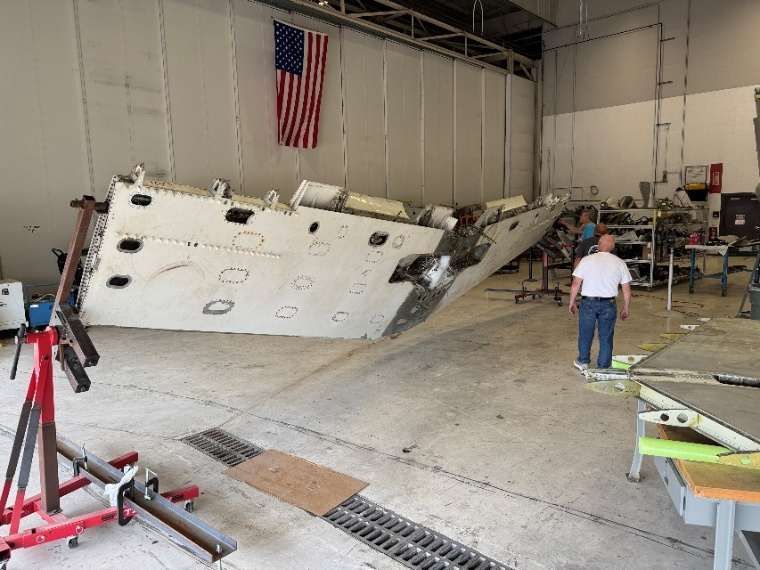
Our March progress has been slowed somewhat because of the construction activity being accomplished in bays 1 and 10 at the north end of building 14. 23-003 is in bay 9 which shares a hangar wall with bay 10. The construction has cut electrical power to this wall, but we are working around this problem. Also, our access to bay 9 now involves having to go through a badge access turnstile which limits our volunteers to those of us who have contractor badges. Even with these construction issues, we are continuing with the cutting and marking of the new wiring for the new wiring harness and tracking parts. Also, the wing that we acquired from 23-024 arrived at building 14 on March 3, 2026. We are using this wing to salvage parts including the leading edges, hydraulic components, etc. that will help with the restoration of 23-003 and needed spares. We are completing the final leveling of the fuselage and securing the supports. This will allow us to remove damaged fuselage skins. With these skins removed, Non-Destructive Inspections (NDI) can continue in order to provide us additional data on the fuselage structural integrity. Ed Grabman, Experimental Test Pilot at the Bombardier Flight Test Center, has agreed to chair the 23-003 Cockpit Configuration Committee. This committee is tasked with determining the cockpit upgrades required to operate 23-003 in the current airspace system while maintaining, as much as possible, the look of the original cockpit. Parts donated by Incora are continuing to arrive with the latest delivery on March 3rd. These much needed, and greatly appreciated, parts include mechanical hardware, aircraft wiring and some electrical components.
By Kristen Nuss March 3, 2026
The tip tanks and keel beam are back in Florida!! S.E.A.L. Aviation has generously volunteered to rebuild and restore our tip tanks and keel beam! Since they are in southern Florida, we loaded them up in a truck for the trip back to Florida. Ron Forshee and Chris Marshall volunteered to make the long drive. They departed Wichita on February 15 th at 12:35 pm and arrived in Florida at the Global Jetcare hangar two days and 1,306 miles later on February 17th. The tip tanks and keel beam will now be taken to the S.E.A.L. facility for restoration. A volunteer has started cleaning the flight controls, ailerons, flaps, etc., so that we can accomplish the necessary detailed inspections. As you can see in the photo below, they are quite dirty after sitting outdoors for years. Volunteers Dan DeMott and Cliff Ives are identifying all of the hydraulic and fuel tubes and components that have been removed from 23-003 with part numbers and Parts Catalog locations. The tubes will also have metal ID tags to facilitate vapor degreasing when the time comes for this operation.  Another milestone was reached late this month in the restoration of 23-003: The fuselage has been firmly tied down, securing it to prevent any movement. This will allow us to now start the necessary structural repairs! In the photos below you can see the cradles and supports securing the fuselage. One cradle just forward of the cabin door, a cradle aft of the cabin window, the jacks on the engine beams, a cradle just aft of the engine pylon and the tail stand.