

Search For Posts
Work continues on the removal of the baggage floor. The process includes removing the fiberglass ducts on the left and right sides of the divan floor, then removal of the step between the divan floor and baggage floor. The photo below, looking aft, shows the various parts included in removing the baggage floor. Note that the right side of the baggage floor has been raised to aid in the removal of the right-hand fiberglass duct. Hartney Hummer removed right hand fiberglass duct on September 10, 2026. In the photo on the right below, where the duct has been removed, you can see the fuselage foam insulation that was hidden behind the duct and will have to be removed using the dry ice blasting technique. Major Wing Decision We have made the difficult decision to replace the wing on 23-003. When we first inspected the 23-003 in Florida on July 20, 2022, we observed corrosion on the left lower wing skin and understood the risk that that would present. After we started the detailed evaluation of the wing in Wichita in the fall of 2024, we found the corrosion to be out of structural limits, meaning a major repair or replacement of the skin was necessary.
It is amazing the progress that our hard working, very dedicated group of volunteers are making on 23-003. Here’s a sample of the various jobs that they do in a single volunteer day: On Tuesday, August 25, 2026, the team was working in unison on several projects: removal of the aft cabin baggage floor, disassembling the main landing gear wheels, using the wiring diagrams to identify switches, connectors, etc., researching the drawings and parts catalog, tagging and storing removed parts. They also held a team meeting to discuss progress, problems encountered and planning the next day’s work projects. We finished removing the fasteners and the enormous amount of sealant that was on the baggage floor on August 6th.. The floor is now completely loose and moving around. However, we discovered that removing it from the fuselage is going to be a lot harder than we thought! According to Jim Tidball, “Talk about a square peg in a round hole!” We put out a request for assistance from anyone that can help us remove this floor and Wes Lumry, a retiree who has been at Learjet since the early days, volunteered. On August 27th he came out to inspect 23-003 and offer his advice on removing the baggage floor. In order to get enough room to lift and rotate the baggage floor to clear the fuselage structure to remove it, we will first have toremove the step between the divan floor and the baggage floor.
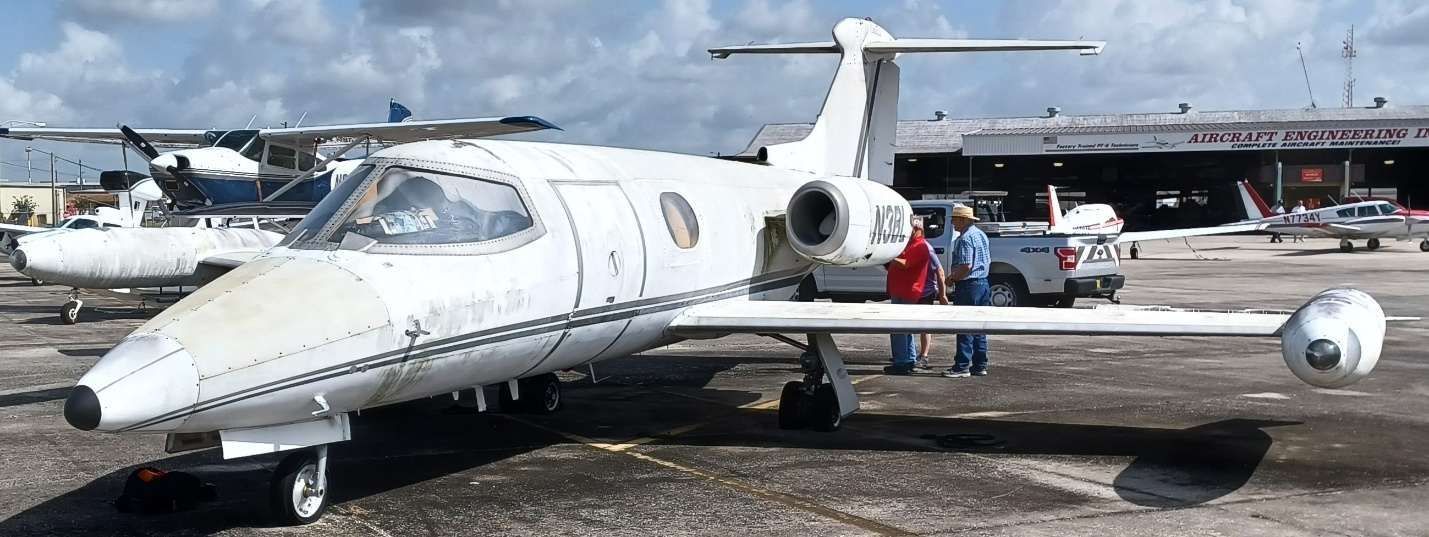
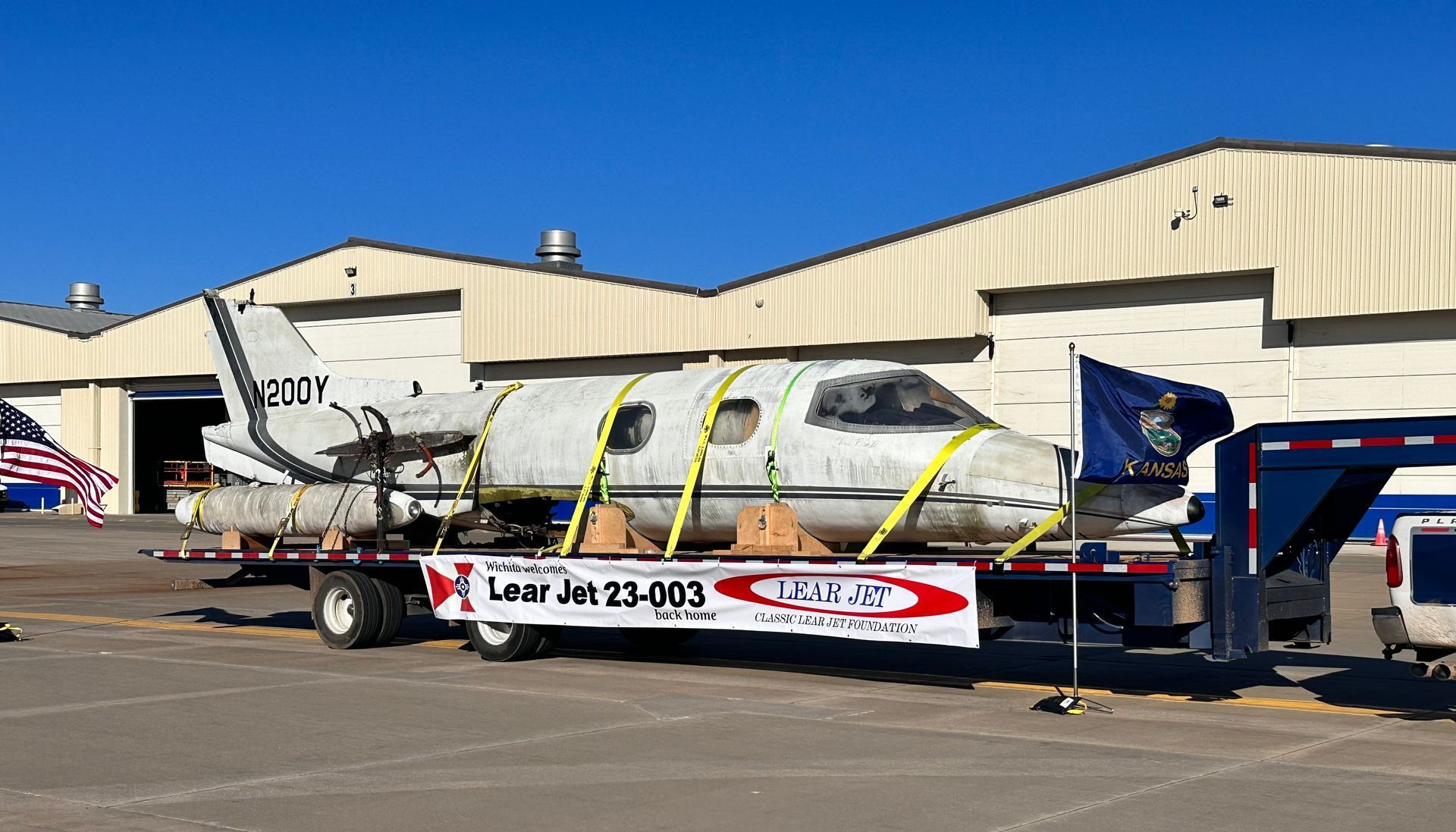
How time flies! A short four years ago, on July 20, 2022, we made our trip to Bartow Executive Airport, Bartow, Florida, to do an inspection of 23-003 to see if she was restorable. Today 23-003 is in Wichita, Kansas within a few hundred feet south of the Lear Jet factory where she was built in 1964. CLJF now owns 23-003 and the restoration project is well along! The latest work by the volunteers has been working on the removal of the aft cabin floor in order to proceed with the structural inspections of the fuselage. It is a slow process because of the large amount of sealant used between the floor and the surrounding structure that has to be manually cut loose before the floor can be removed. Also, all the parts removed from the airplane continue to be identified, inspected, and dispositioned for service, replacement or overhaul. A big THANK YOU to all the volunteers! We greatly appreciate all that you do!
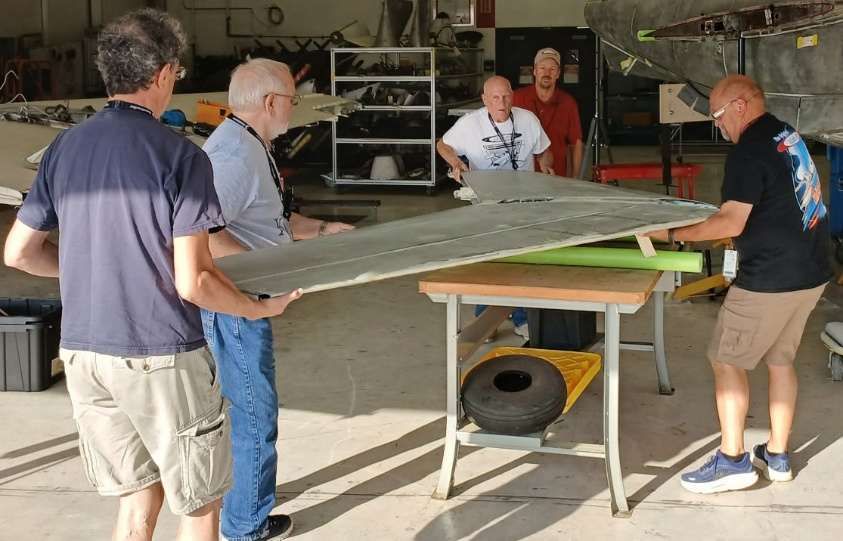
Throughout the construction going on in bays 1 and 10 in building 14, our dedicated volunteers continue to make significant progress. On June 4, 2026 they removed the leading edges from the horizontal stabilizer. This will allow us to start the structural inspection. Once completed, it will be transported to DAS Aviation for restoration. Also, on June 4th, the wing from 23-028, that we acquired for parts, was removed from the wing dolly and installed on the ‘rotisserie’ by volunteers Jim Tidball, Dan DeMott, Hartney Hummer and Al Goodwin. Next, we will check the condition of the wing by performing a leak test on each wing and start removing parts from various wing systems. The daunting task of making a new wiring harness to replace the existing 62-year-old wiring harness continues. On June 9th we caught volunteers Bud Ledom, Rob Bielman and Dave Dendurant hard at pouring over drawings identifying the wires, connectors, switches, etc. A Memorandum of Agreement (MOA) between the CLJF and Embry-Riddle Aeronautical University (ERAU) was signed on May 28th. This MOA details the responsibilities of each of us for the restoration of the landing gear. On June 10, 2026, Jim Long and his son, Zach, of Noble Jet, picked up the landing gear retraction actuators and the box of various hydraulic actuators. There they will be tested and rebuilt. Thank You Noble Jet!!
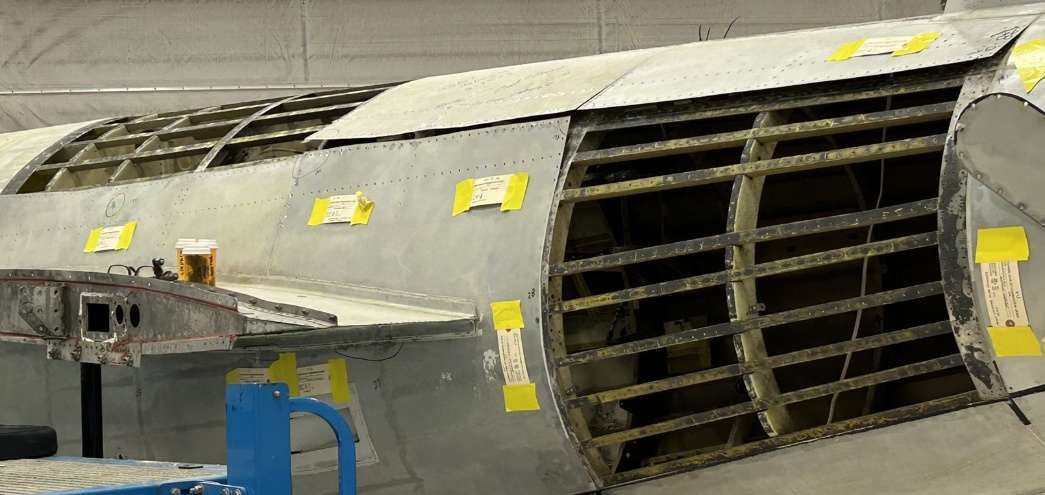
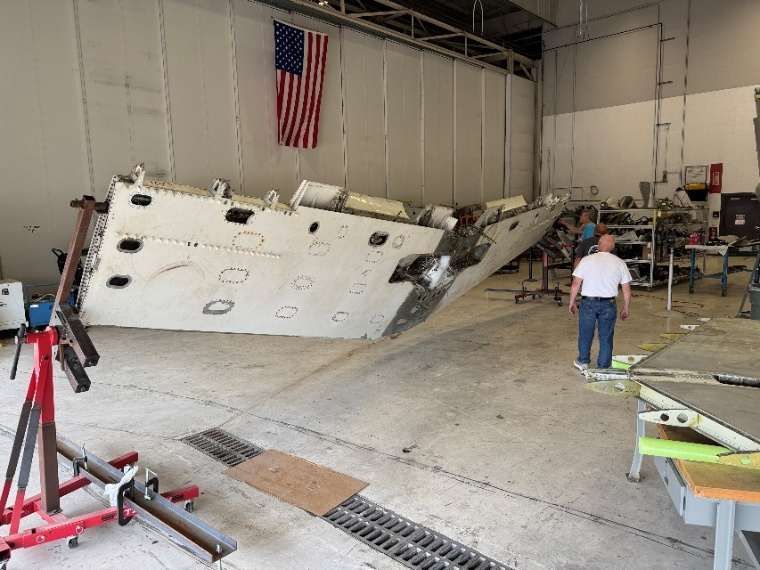
This month we removed the skin from the top of the aft fuselage, above the engine pylons. Three more fuselage skins are in the process of being removed as shown in the photo below. Removal of the skins is the only way for us to do visual inspections of the structure and to give access for future X-ray inspections. Areas of suspected corrosion, circled in the following photo, will be exposed with the removal of these skins. Visual and X-ray inspections will be conducted to verify the condition of the underlying structure. Then, if required, repairs or replacement of the structure will be accomplished. On May 22, 2026 the landing gear and several actuators were loaded onto Chris Marshall’s truck by Chris, Ron Forshee and Dick Kovich to be driven to Florida by Chris and his wife, Darla, where they will be restored. The landing gear will be restored by Embry-Riddle Aeronautical University (ERAU) in Daytona, Florida. The landing gear actuators and a box of miscellaneous smaller hydraulic actuators will be tested and rebuilt by Noble Jet in Fort Lauderdale, Florida. A huge Thank you to both ERAU and Noble Jet!!!
April was a historic month in the restoration of 23-003 N200Y!! First, on April 14 th , after final leveling, the fuselage cradles, jacks and supports were secured firmly to the hangar floor with a special plaster mixture containing hemp fibers (some ropes are made with these fibers). This plaster mixture is commonly used on the factory floor to set tooling jigs so that they cannot move ensuring accurately produced parts and assemblies. With the fuselage secured, we were able to start the removal of skins from the fuselage that need replacement or repair. On April 21, 2026 Hartney Hummer removed the 1st skin panel!! This panel is on the left side of the fuselage, just aft of the engine pylon. This particular panel is not repairable and will have to be replaced. Removal of this panel will also allow the non-destructive inspections (NDI) of the aft fuselage to continue. The NDI test equipment is too big to fit inside the aft fuselage so it will be positioned outside of the stringers pointing inside. International Turbine Industries (ITI) has started the restoration of our CJ610-1 engines. The inspection of the engine cases has started in preparation for them being shipped out to have a coating applied. During earlier discussions between ITI and CLJF, we decided that during the restoration, the engines will be upgraded to the ‘dash 4’ (CJ610-4) configuration. The CJ610-4 engine is a previously approved FAA configuration for the Model 23.

